
If You have repeatedly asked the question “What Gaming Monitor Should I Buy” then there is no single “best” gaming monitor option. The right display depends on the resolution your GPU can handle, the FPS you actually get, the games you play, and whether you’re planning a future GPU upgrade.
A PC running demanding AAA games at 55–70 FPS has very different needs from one pushing 200+ FPS in Valorant, even with similar hardware. The first may benefit more from a good 1080p or 1440p VRR display, while the second can genuinely use a much faster monitor.
Buying more monitor than your PC can currently exploit isn’t automatically a mistake. A good display can survive several GPU upgrades. The mistake is paying extra for resolution or refresh rate without knowing whether you’ll actually use it.
| Your gaming situation | Sensible starting point |
|---|---|
| Entry-level or older PC, demanding games | 1080p 75–120Hz with VRR |
| Budget PC, mixed gaming | 1080p 120–180Hz |
| Budget PC, competitive games | 1080p 165–240Hz |
| Mid-range PC, demanding games | 1440p 120–180Hz |
| Mid-range PC, high-FPS gaming | 1440p 165–240Hz |
| High-end gaming PC | 1440p high refresh or 4K 120Hz+ |
| Very high-end or competitive setup | 240Hz+ where your FPS can justify it |
Notice that 1080p is not treated as the “bad” option here. It remains an extremely sensible gaming resolution, particularly on budget hardware and high-FPS competitive systems. Moving to 1440p or 4K only makes sense if the improvement in image quality is worth the extra work you are asking your GPU to do.
If you already know roughly what class of monitor your system needs and just want actual models to compare, my best gaming monitors by budget guide is the better place to shop. Here, we are going to work out which class of monitor makes sense first.
Start With the FPS Your PC Actually Produces
Do not choose a monitor from your GPU name alone. “I have an RTX 4060, what monitor should I buy?” leaves out the information that actually matters: how your games perform.
The same PC might produce 55 FPS in a demanding AAA game, 90 FPS in something lighter, and more than 200 FPS in an esports title. Those situations do not need the same monitor.
Run several games you actually play at your normal resolution and settings and note the FPS during real gameplay. You do not need an elaborate benchmark. You simply want to know whether your PC typically sits around 50–70 FPS, 80–120 FPS, 140–180 FPS, or much higher.
If you are not sure how to measure that, use my guide to testing gaming PC performance. It covers FPS, temperatures and hardware behaviour without the guesswork.
Use representative games. If you mainly play Cyberpunk 2077 or Baldur’s Gate 3, a 300 FPS Counter-Strike result tells you little about your normal monitor needs. Likewise, a competitive player should not choose a display around one brutally demanding single-player game.
The goal is to find your realistic gaming performance range. Once you know that, choosing the right resolution and refresh rate becomes much easier.
Choose Your Resolution Before You Choose Your Refresh Rate
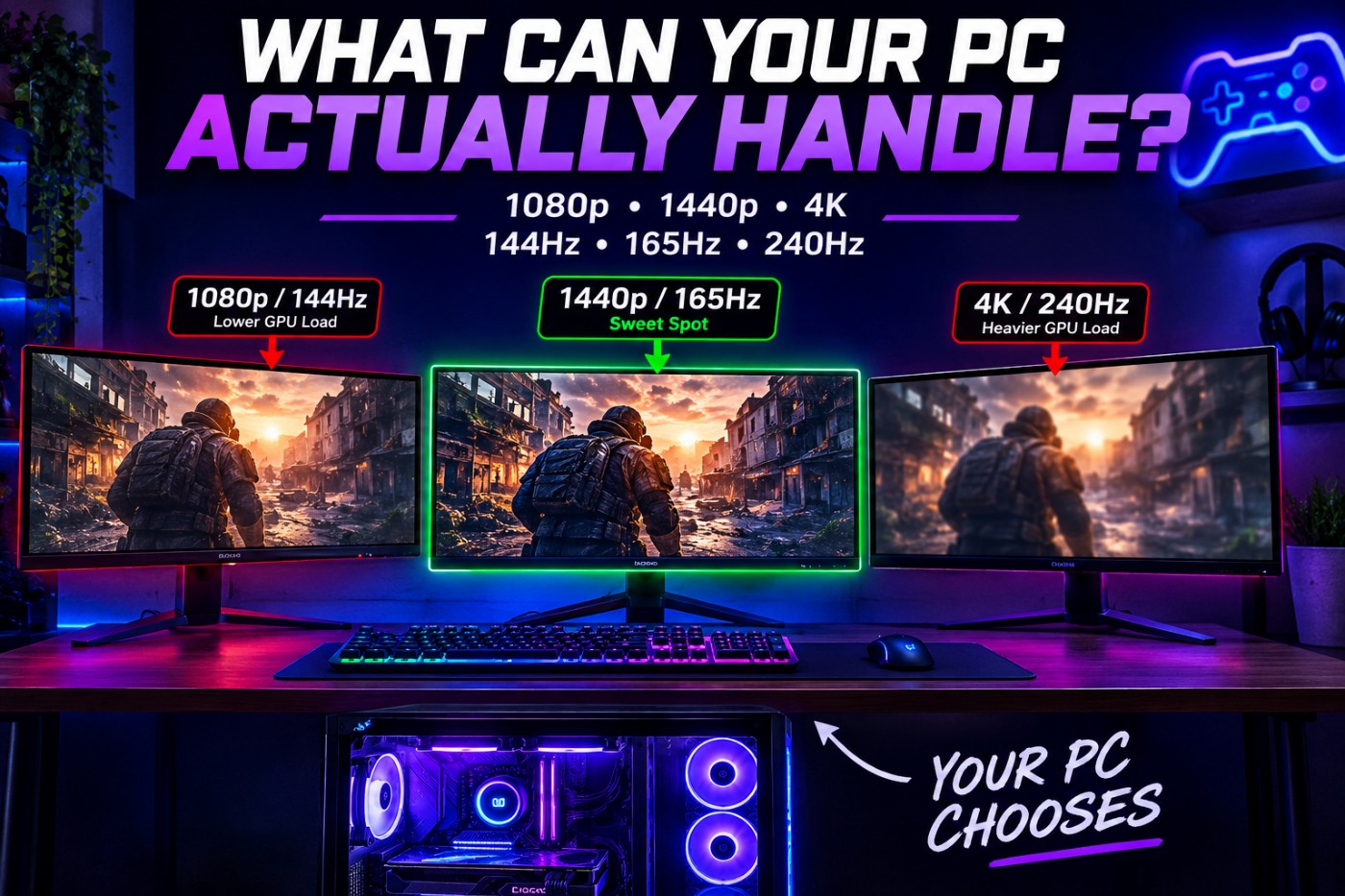
Before worrying about 144Hz, 165Hz or 240Hz, decide what resolution your PC can realistically handle. Moving from 1080p to 1440p or 4K increases GPU workload, so the real question is: can your PC deliver the performance you want at that resolution?
1080p: Still a Smart Choice for Plenty of Gaming PCs
1080p is not obsolete. For older GPUs, budget systems and competitive gaming, its lower rendering load makes high frame rates much easier to maintain. If you would rather play at 120–180 FPS than sacrifice performance for extra sharpness, a good 1080p high-refresh monitor can be the smarter choice.
That is also why 1080p remains one of the most widely used gaming resolutions. There is no reason to force modest hardware into 1440p simply because newer monitors support it.
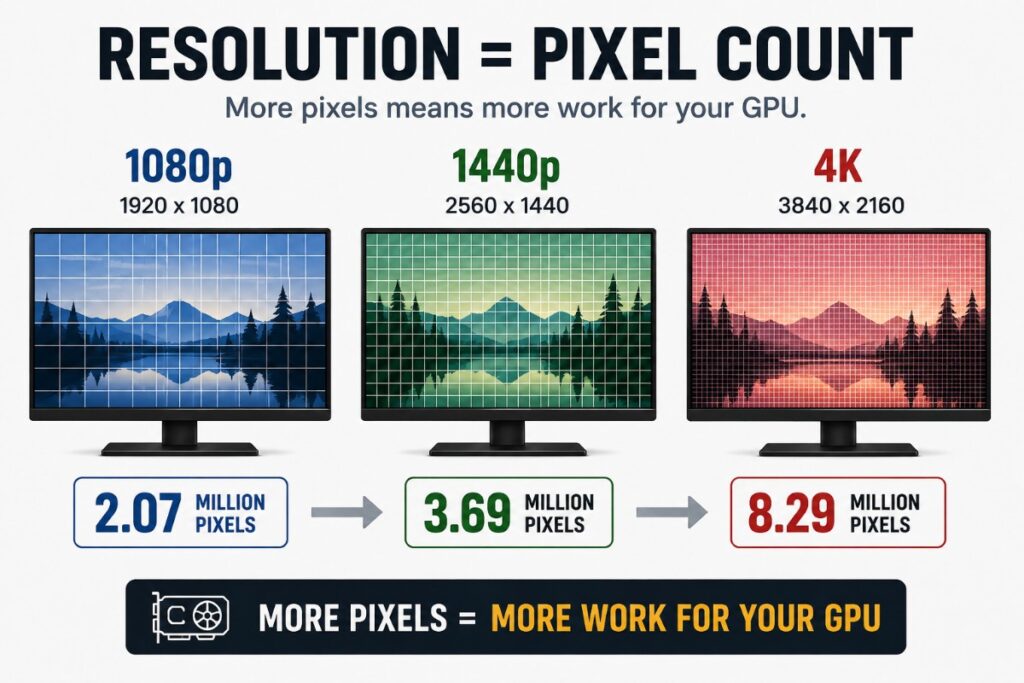
1440p: More Detail, but Your GPU Has to Pay for It
1440p gives you noticeably more detail than 1080p, particularly on a 27-inch display, without demanding as much GPU power as 4K. It is a strong upgrade when your PC has enough performance headroom.
But ignore the claim that 1440p is automatically the gaming “sweet spot.” If moving from 1080p to 1440p drops a game from 120 FPS to 65–80 FPS, you need to decide whether the extra sharpness is worth that trade.
If you are unsure where your GPU fits, my guide to GPUs for 1080p and 1440p gaming goes deeper into that decision.
4K delivers excellent image clarity, especially on larger displays, but the much higher pixel count puts significantly more load on your GPU.
You do not need the fastest GPU available to play at 4K. Upscaling, graphics settings and the games you play all matter. But if high FPS is your priority, 4K can become an expensive way to make your GPU work harder, and your processor matters too. Our guide to whether 4-core CPUs are still enough for gaming explains why older processors can become much easier to expose when you start chasing higher frame rates.
Choose the resolution that delivers the experience you want. Once that is settled, choosing the right refresh rate becomes much easier.
4K: Fantastic When the Hardware Can Back It Up
What Refresh Rate Should You Actually Buy?
Refresh rate is how often your monitor can update the image each second. Higher refresh rates can make motion smoother and reduce latency, but more Hz is not automatically better value. The sensible target depends on the FPS your games actually produce.
60–75Hz: Fine When Budget or Hardware Is the Limit
A 60–75Hz display can still work for very weak PCs, slower games or extremely tight budgets. But if your PC regularly produces well above 60 FPS, a new 60Hz gaming monitor leaves much of that extra performance unseen.
100–120Hz: An Underrated Upgrade for Modest PCs
For a modest PC often running around 70–110 FPS, a 100–120Hz display can be an excellent step up from 60Hz without paying for refresh-rate headroom you are unlikely to use.
144–180Hz: The Sensible High-Refresh Range
For PCs regularly producing triple-digit frame rates, 144–180Hz offers a strong balance for both competitive and single-player gaming. It also provides useful headroom, and you do not need to hit 165 FPS constantly to benefit from a 165Hz monitor.
240Hz: Worth It When You Actually Play at High FPS
240Hz makes more sense when your PC regularly produces very high frame rates and responsiveness matters, particularly in competitive shooters. If most of your games run at 70–100 FPS, paying a large premium for 240Hz is much harder to justify.
360Hz and Beyond: Specialist Territory
360Hz and faster displays target players chasing extremely high frame rates and minimal latency. That has a legitimate place in serious competitive gaming, but it is not a normal requirement for PC gaming. If your system rarely approaches those frame rates, do not pay for them just because the number looks impressive.
Does Your FPS Need to Match Your Monitor’s Refresh Rate?
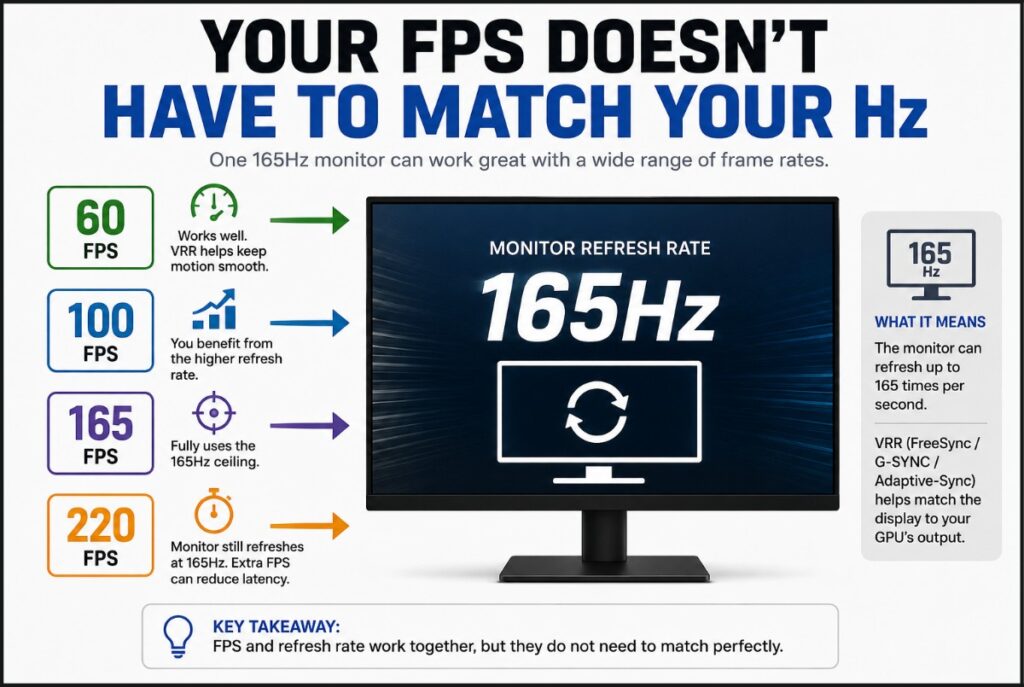
No. A 165Hz monitor does not require your PC to produce 165 FPS constantly. Think of 165Hz as the monitor’s maximum refresh capability, not an FPS requirement.
| Gaming performance | What happens on a 165Hz monitor |
|---|---|
| 60 FPS | The game still runs at 60 FPS. A good VRR monitor can match its refresh rate to the changing frame output and keep motion smoother. |
| 100 FPS | You can benefit from the higher refresh rate even though you are below 165 FPS. |
| 165 FPS | Your PC is producing enough frames to make full use of the monitor’s maximum refresh rate. |
| 220 FPS | The game can render more frames than the monitor can display as complete refreshes, although the additional FPS can still reduce input latency. |
This is where variable refresh rate (VRR) matters. FreeSync, G-SYNC and VESA Adaptive-Sync allow a compatible monitor to adjust its refresh timing around the frames your GPU is producing instead of refreshing at one fixed rate.
That is useful because gaming FPS rarely stays perfectly stable. If performance moves between 85 and 120 FPS, VRR can follow those changes and reduce visible tearing as the frame rate moves around.
So forget the rule that “100 FPS means I need a 100Hz monitor.” A 144Hz or 165Hz VRR display can still be an excellent match and leave useful headroom for faster games or a future GPU upgrade.
The reverse matters too. If your PC produces 200 FPS on a 60Hz monitor, the display cannot show all of those frames as complete refreshes, even though higher FPS can still reduce latency. If you regularly run very high frame rates, my guide to capping FPS explains why unlimited FPS is not always the smartest way to use that performance.
Match the Monitor to the Games You Actually Play
Your GPU is only half the story. The games you actually play should influence the monitor you buy just as much as the hardware inside your PC. The same system might struggle to reach 80 FPS in a demanding AAA game but push beyond 200 FPS in a competitive shooter.
Competitive FPS: Prioritise Frames and Motion
If you mainly play Valorant, Counter-Strike 2 or Overwatch 2, high refresh rates are easier to justify. These games can run at high FPS, where smoother motion and fast response characteristics become more valuable.

Staying at 1080p can also make sense if moving to 1440p costs too much performance. A stronger PC may give you both, but resolution should not automatically outrank FPS for a competitive player. If you regularly push high frame rates, 165Hz or 240Hz becomes a realistic target rather than an impressive number on the box.
AAA and Cinematic Games: Image Quality Matters More
If you mainly play demanding single-player games, chasing 240 or 360 FPS is rarely the priority. Resolution, image quality, VRR and good HDR can matter more than extreme refresh rates.
A good 1440p or 4K display running a game smoothly at a lower frame rate may deliver a better experience than sacrificing image quality just to chase FPS. Higher refresh is still useful, but there is little reason to pay heavily for refresh rates your games and hardware will rarely exploit.
Mixed Gaming: Find the Middle Ground
If you play a bit of everything, balance matters. For many capable PCs, 1080p or 1440p at around 144–180Hz is a sensible place to start, giving single-player games good image quality while leaving useful refresh-rate headroom for shooters and faster games. Your actual FPS should still decide whether 1440p and the higher refresh rates are worth paying for.
Strategy, RPG and Slower Games: Stop Paying for Hz You Don’t Need
High refresh still feels good in RPGs, strategy games and slower titles, but the returns shrink when you start paying heavily for performance those games barely use. If you spend more time exploring worlds or managing armies than tracking targets, better resolution, contrast, panel quality or HDR may matter more than jumping from 165Hz to 360Hz.
The question is not “Which monitor has the best specs?” It is “Which specs improve the games I actually play?”
Gaming Monitor Recommendations by PC Performance
Now we can put everything together. Instead of assigning one monitor to every graphics card, use the performance your PC actually delivers as the starting point.
| Your PC typically delivers | Resolution target | Refresh-rate target | Best suited to |
|---|---|---|---|
| Under ~60 FPS | 1080p | 75–120Hz with VRR | Older and entry-level PCs |
| ~60–100 FPS | 1080p or 1440p | 100–144Hz | General gaming |
| ~100–165 FPS | 1080p or 1440p | 144–180Hz | Strong mixed gaming |
| ~165–240 FPS | 1080p or 1440p | 180–240Hz | High-FPS and competitive gaming |
| 240 FPS+ | 1080p or 1440p | 240Hz+ | Serious competitive gaming |
| Strong 4K performance | 4K | 120–240Hz | High-end gaming and image quality |
The most important part of this table is what it doesn’t say. There is no row claiming that an RTX 4060 automatically belongs with one monitor or that every high-end GPU needs 4K. Your real gaming performance is more useful than the badge printed on your graphics card.
For example, if your PC usually delivers 80–100 FPS in the games you care about, a good 120Hz or 144Hz VRR monitor gives that performance somewhere useful to go. You can still buy 165Hz for extra headroom, particularly if the price difference is small, but you do not suddenly need 240Hz.
Likewise, a PC producing 180–220 FPS in competitive games can make a 240Hz display much easier to justify. But if that same PC spends most of its time running demanding single-player games at 80 FPS, you may get more value from better resolution or image quality instead.
And do not downgrade a monitor simply because your FPS occasionally falls below its maximum refresh rate. VRR exists precisely because gaming performance moves around. These ranges are meant to help you avoid ridiculous mismatches, not force your FPS and refresh rate into identical numbers.
If you have reached this point and know roughly which resolution and refresh-rate class fits your PC, you can move from theory to actual models with my gaming monitors by budget guide. Do that after you know what your PC needs, not before.
What If Your PC Is Low-End or Uses Integrated Graphics?
If your PC uses integrated graphics or an older GTX or RX card, the answer is not to buy the cheapest 60Hz monitor you can find and accept defeat. You simply need to match the display to what your hardware does well.
Start with resolution. For genuinely weak hardware, 1080p remains the sensible target for a new monitor even if some demanding games need to be rendered at lower settings, use upscaling, or occasionally drop below native resolution to remain playable. Older systems may still end up running certain games at 900p or even 720p, but that does not mean buying a 720p monitor makes sense.
This is especially important with integrated graphics. Intel UHD-class hardware and older AMD integrated graphics can run plenty of games, but performance varies enormously between a lightweight esports title and a demanding modern AAA release. If you are gaming without a dedicated GPU, my Intel HD Graphics Gaming Guide shows just how much the playable resolution and settings can change across weaker integrated graphics.
A Weak GPU Does Not Automatically Mean a 60Hz Monitor
This is where low-end PC advice often gets lazy. A weak graphics card does not produce 40 FPS in every game simply because it is weak.
You might get 40–60 FPS in a demanding game and well over 100 FPS in an older or competitive title. If you regularly play lightweight shooters, esports games or older PC games, an affordable 100–144Hz monitor can still make sense even though your hardware would never sustain those frame rates in the latest AAA releases.

VRR is particularly valuable here. Low-end PCs tend to spend more time moving through awkward frame-rate ranges rather than sitting comfortably at one fixed number. If a game shifts between 55, 70 and 90 FPS as scenes become more demanding, a compatible variable-refresh monitor can make those fluctuations less disruptive than they would be on a fixed-refresh display.
So if your PC is modest, do not chase resolution simply because 1440p and 4K monitors exist. A solid 1080p 100–144Hz VRR display may give you a much better gaming experience than asking the same hardware to push substantially more pixels.
And if you are unsure whether the PC itself is ready for an upgrade, start with what to upgrade first on a low-end PC before spending money on hardware that may not solve your actual limitation.
Should You Buy a Better Monitor Than Your PC Can Use Today?
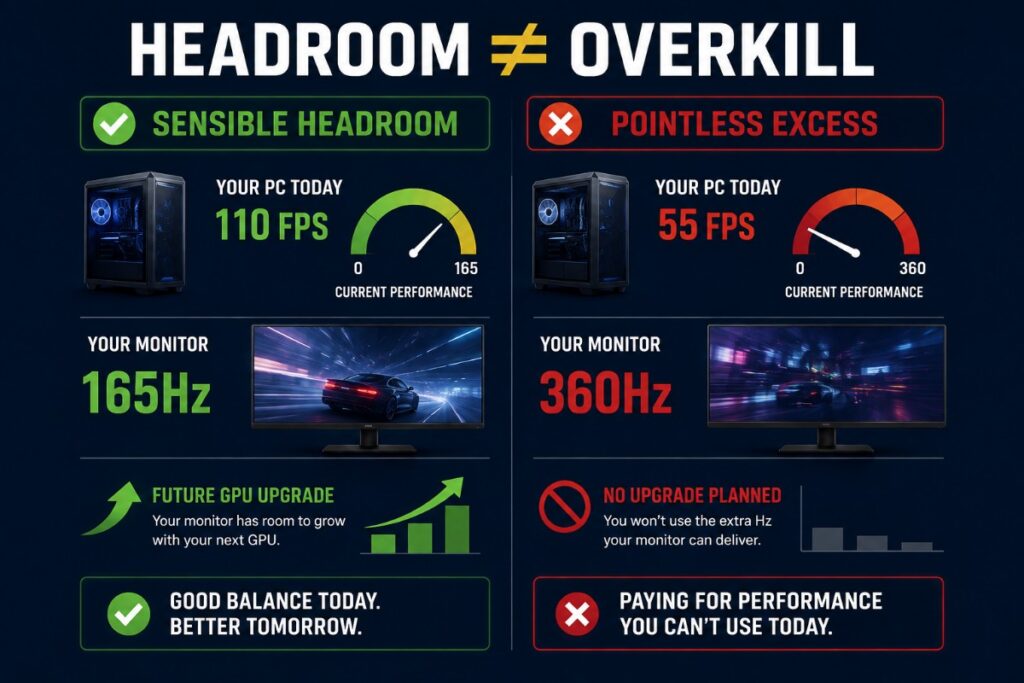
Sometimes, yes. Monitors often survive several PC upgrades, so buying some performance you cannot fully use today can be sensible. The key is knowing the difference between sensible headroom and pointless excess.
If your PC produces around 100–130 FPS at 1080p, buying a 165Hz monitor leaves useful room for faster games and a future GPU. Moving to 1440p before a planned GPU upgrade can also make sense, provided you accept that today’s GPU may need lower settings or upscaling.
But future-proofing becomes overspending when there is no realistic plan to use what you are buying. Paying heavily for 360Hz when you mostly play demanding games at 50–70 FPS, or buying 4K only to spend years struggling to run it, is not useful headroom.
Buy enough headroom for your next upgrade, not the next decade. If you are planning a hardware change, my gaming PC upgrade order guide can help you decide where the monitor fits.
Should You Upgrade Your Monitor or GPU First?
This is where the numbers on the box stop mattering and the actual weakness in your setup takes over. Upgrade whichever component is preventing you from getting the experience you want.
| Your situation | Upgrade first | Why |
|---|---|---|
| Low FPS at the resolution and settings you want | GPU | A faster monitor cannot fix poor rendering performance |
| High FPS but still using a 60/75Hz monitor | Monitor | Your PC is producing performance the display cannot fully show |
| GPU cannot comfortably handle your desired resolution | GPU | More display resolution only increases the rendering demand |
| Existing monitor has poor VRR, motion handling or image quality | Monitor | The display itself is now limiting the experience |
| Both GPU and monitor are weak | It depends | Your games, current FPS and budget should decide which limitation matters more |
Weak GPU, Decent Monitor? Upgrade the GPU
If your monitor already has a sensible resolution, refresh rate and VRR but your games struggle at 40–55 FPS, another monitor solves the wrong problem. A faster display cannot create frames your GPU cannot render.
Strong GPU, Old 60Hz Monitor? Upgrade the Monitor
If your PC already produces 120, 160 or 200 FPS on a 60Hz display, the monitor is now holding back what you can actually see. A suitable high-refresh display lets you make far better use of performance you already have.
Weak GPU and Old Monitor? It Depends
If demanding games struggle to reach 60 FPS, the GPU is probably the priority. But if lightweight competitive games already run above 120 FPS, replacing an old 60Hz monitor could make the bigger difference.
If both need attention, find the actual limitation before spending. My guide to finding what’s bottlenecking your gaming PC will help you identify what is really holding the system back.
Competitive Gaming at 180+ FPS on 60Hz? Upgrade the Monitor
If your competitive games already run at 180 FPS or more on a 60Hz or 75Hz display, the PC is doing its part. A 165Hz or 240Hz monitor lets you make much better use of that performance.
Do not upgrade the component with the least impressive specification. Upgrade the component that is actually limiting your experience.
What Monitor Specs Matter After Resolution and Refresh Rate?
Once resolution and refresh rate are sorted, the remaining specs help separate a good monitor from a bad one. They matter, but none can fix a display that is fundamentally mismatched to your PC.
Panel Type: IPS, VA or OLED?
IPS is a strong all-round choice with good colour, viewing angles and motion performance. VA usually offers better contrast and deeper blacks, although some panels suffer from dark smearing. OLED and QD-OLED deliver exceptional contrast, true blacks and very fast response, but cost considerably more and still require some consideration around burn-in.
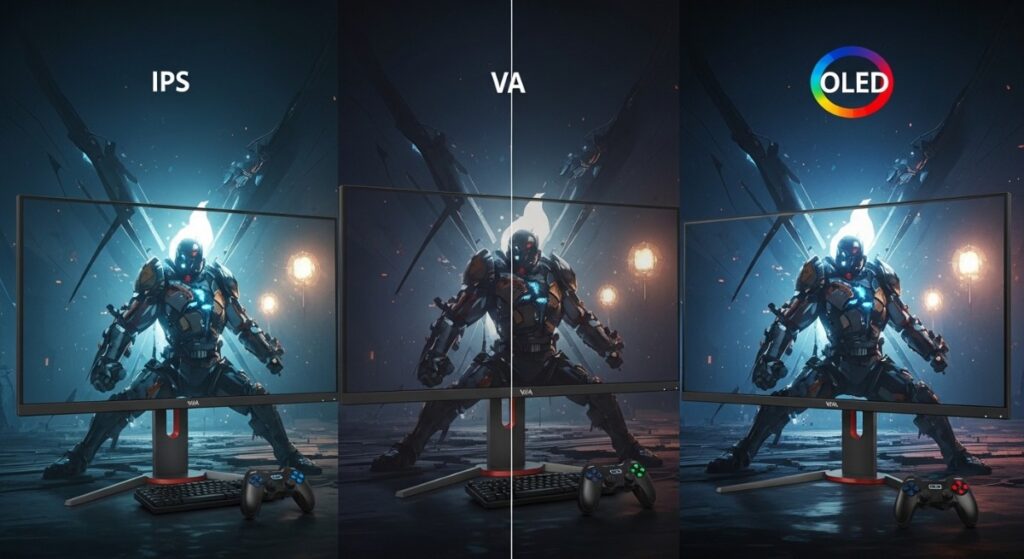
Do not assume OLED is automatically the right answer. For a budget gaming PC, a good IPS monitor with the right resolution and refresh rate can be the much smarter purchase.
Response Time: Don’t Buy a Monitor Because It Says “1ms”
Faster pixel response helps keep motion clear, but advertised “1ms” figures are poor shopping tools on their own. Real response times vary across transitions and settings, while aggressive overdrive can introduce overshoot or inverse ghosting. Use independent testing when comparing specific monitors instead of choosing the lowest advertised number.
Adaptive Sync: One Feature Worth Prioritising
FreeSync, G-SYNC and Adaptive-Sync can match the monitor’s refresh timing to changing GPU output, reducing tearing and making fluctuating FPS feel more consistent. That is especially useful on budget and mid-range PCs where a game might move between 70 and 110 FPS instead of holding one fixed number.
Check the monitor’s actual VRR support and operating range, because implementation quality still varies between models.
HDR: Don’t Buy the Logo
Good HDR can improve highlights, contrast and dark scenes, but simply accepting an HDR signal does not make a monitor good at HDR. Brightness, contrast, colour capability and control over light output all matter. Judge the monitor’s actual HDR performance, not the logo on the box.
Size: Match It to the Resolution
24-inch 1080p remains a sensible combination for budget and competitive gaming, while 27-inch 1440p gives you more space and greater pixel density. At around 32 inches, 4K becomes increasingly attractive if your PC and budget can support it. Viewing distance and preference still matter, so treat these as guidelines rather than rules.
If you want to dig deeper into panel types, HDR, response times and other monitor specs, my Gaming Monitor Buying Guide covers them in more detail.
The Gaming Monitor Specs You Probably Don’t Need to Pay Extra For
Monitor manufacturers are very good at turning bigger numbers into reasons to spend more money. Your job is to work out whether those numbers improve your gaming experience.
- 360Hz+ when your games run around 80 FPS. You are paying heavily for refresh-rate capability your normal gaming workload barely approaches.
- 4K when your GPU already struggles at lower resolutions. More pixels are not an upgrade if reaching playable performance forces you into compromises you hate.
- Expensive HDR branding without good HDR hardware. An HDR logo does not guarantee strong contrast, brightness or useful local dimming.
- OLED simply because OLED is “the best.” OLED can look spectacular, but a well-matched IPS monitor plus money left for a needed GPU upgrade can produce a much better overall gaming setup.
- A huge screen at insufficient resolution. Bigger does not automatically mean sharper or better when the same number of pixels is being stretched over more screen area.
- Features you will never use. Premium connectivity, extreme refresh rates and specialist gaming features have zero value if they solve problems you do not have.
This is not an argument against expensive monitors. A premium display can be worth every cent when you have the hardware, games and budget to exploit what it offers. The rule is much simpler: pay for benefits you can actually see or use.
How to Choose the Right Gaming Monitor in Five Minutes
If all the specifications are starting to blur together, ignore the marketing and run through this five-step check.
1. Start With the Resolution and Settings You Actually Use
Look at how you play now. If your PC is already working hard at 1080p, blindly moving to 1440p or 4K is asking the GPU to do considerably more work. If you have plenty of performance left, a higher-resolution monitor becomes much easier to justify.
2. Measure Your FPS in the Games You Actually Play
Check several representative games rather than one benchmark. You need a realistic performance range, not one flattering number from the easiest game your PC can run.
3. Decide What You Care About More
Competitive players generally have more reason to prioritise high refresh rates. Players who spend most of their time in visually demanding single-player games may get more value from resolution, contrast, HDR and overall image quality.
4. Match Resolution and Refresh Rate to That Performance
Choose a monitor class that gives your current PC somewhere useful to put the frames it already produces. Do not force an exact FPS-to-Hz match, and do not forget VRR when your frame rate fluctuates.
5. Add Sensible Headroom
If the next refresh-rate tier costs only a little more, or you know a GPU upgrade is coming, buying some unused capability today can be sensible. Just keep the distinction clear: sensible headroom is planning; pointless excess is paying for specifications with no realistic use.
The whole decision can be reduced to this:
PC performance → resolution → real gaming FPS → refresh rate → monitor.
Not:
biggest specification → biggest number → buy.
Once you know the resolution, refresh-rate range and features that make sense for your PC, then start comparing actual products. My Best Gaming Monitors by Budget guide is designed for that next step.
Gaming Monitor FAQ
Q: What refresh rate should I get for gaming?
A: Choose it around the FPS your PC actually produces and the games you play. Around 100–144Hz can make sense for modest systems, while 144–180Hz gives capable mixed-gaming PCs useful headroom. 240Hz and above becomes easier to justify when you regularly play at very high frame rates, particularly in competitive games.
Q: Is 1440p worth it over 1080p?
A: Yes, if your GPU can deliver the performance you want at 1440p. The extra resolution improves image clarity, but it also increases GPU workload. If moving to 1440p forces your frame rate below the level you enjoy, 1080p can still be the smarter choice.
Q: Can I use a 165Hz monitor if I only get 100 FPS?
A: Absolutely. Your FPS does not need to equal the monitor’s maximum refresh rate. A 165Hz VRR monitor can work very well at 100 FPS while also giving faster games and future hardware additional refresh-rate headroom.
Q: Is a 240Hz monitor worth it if I don’t get 240 FPS?
A: It can be, especially if you play competitive games, sometimes reach much higher frame rates or plan to upgrade your GPU. But if most of your games run far below 240 FPS and the monitor costs substantially more, the extra refresh rate becomes increasingly difficult to justify.
Q: Should I upgrade my GPU or monitor first?
A: Upgrade the GPU first if poor rendering performance is stopping you from reaching the resolution, settings or FPS you want. Upgrade the monitor first if the PC already produces strong performance that your existing display cannot properly take advantage of.
Q: Is 1080p still good for gaming?
A: Yes. 1080p remains particularly useful for budget PCs, older graphics cards and competitive gaming where maintaining high frame rates can matter more than increasing resolution. Moving to 1440p is an upgrade only when the extra image quality is worth the additional GPU workload.
The Right Gaming Monitor Is the One Your PC Can Actually Use
You do not need the fastest, highest-resolution or most expensive gaming monitor to get a meaningful upgrade. You need the display that makes sense for the performance your PC actually produces.
If your system is happiest at 1080p and 100–140 FPS, there is nothing second-rate about building around that. If your GPU can comfortably push 1440p at high frame rates, give it a monitor that can show that performance. And if you have the hardware for 4K high-refresh gaming, then the expensive end of the monitor market finally starts earning its keep.
The mistake is buying backwards: choosing 4K, 240Hz, OLED or whatever specification currently looks impressive and then hoping your PC can justify it.
Start with your games. Measure your performance. Choose the resolution. Match the refresh rate. Then spend your money.
Once you know what your PC can genuinely make use of, head to my Best Gaming Monitors by Budget guide and find the best display that fits both your hardware and your budget.